"Because I said so!" The words escaped my mouth before I could catch them. I froze, hearing my mother's voice echo through decades. In that moment, facing my frustrated 6-year-old, I had become exactly what I promised myself I wouldn't.
Sound familiar? That sinking feeling when you hear yourself repeating the very phrases that made you feel small, dismissed, or misunderstood as a child is one of parenting's most jarring moments. One mom in our community recently shared, "I swore I'd never use the 'wait until your father gets home' threat, but last week, overwhelmed and exhausted, those exact words tumbled out. I felt like a fraud."
You're not alone. Nearly every parent I've worked with has experienced this uncomfortable déjà vu. What's fascinating isn't that it happens (our brains are literally wired for these patterns), but that with the right awareness and tools, we can interrupt these cycles mid-sentence.
In today's newsletter, I'm sharing the science behind these triggered responses and the practical, in-the-moment strategies to rewrite your parenting script—even when your buttons are being enthusiastically pushed. By the end, you'll understand why your brain defaults to these inherited phrases and have concrete alternatives ready for your next challenging moment.
Because breaking generational patterns isn't just about saying different words—it's about creating an entirely new emotional legacy for your children.

Why We Repeat What We Promised to Avoid
When your child pushes your buttons and you suddenly channel your own parent's voice, what's actually happening in your brain?
Your prefrontal cortex—the rational, thoughtful part of your brain—gets temporarily overridden by your limbic system. This evolutionary response happens because:
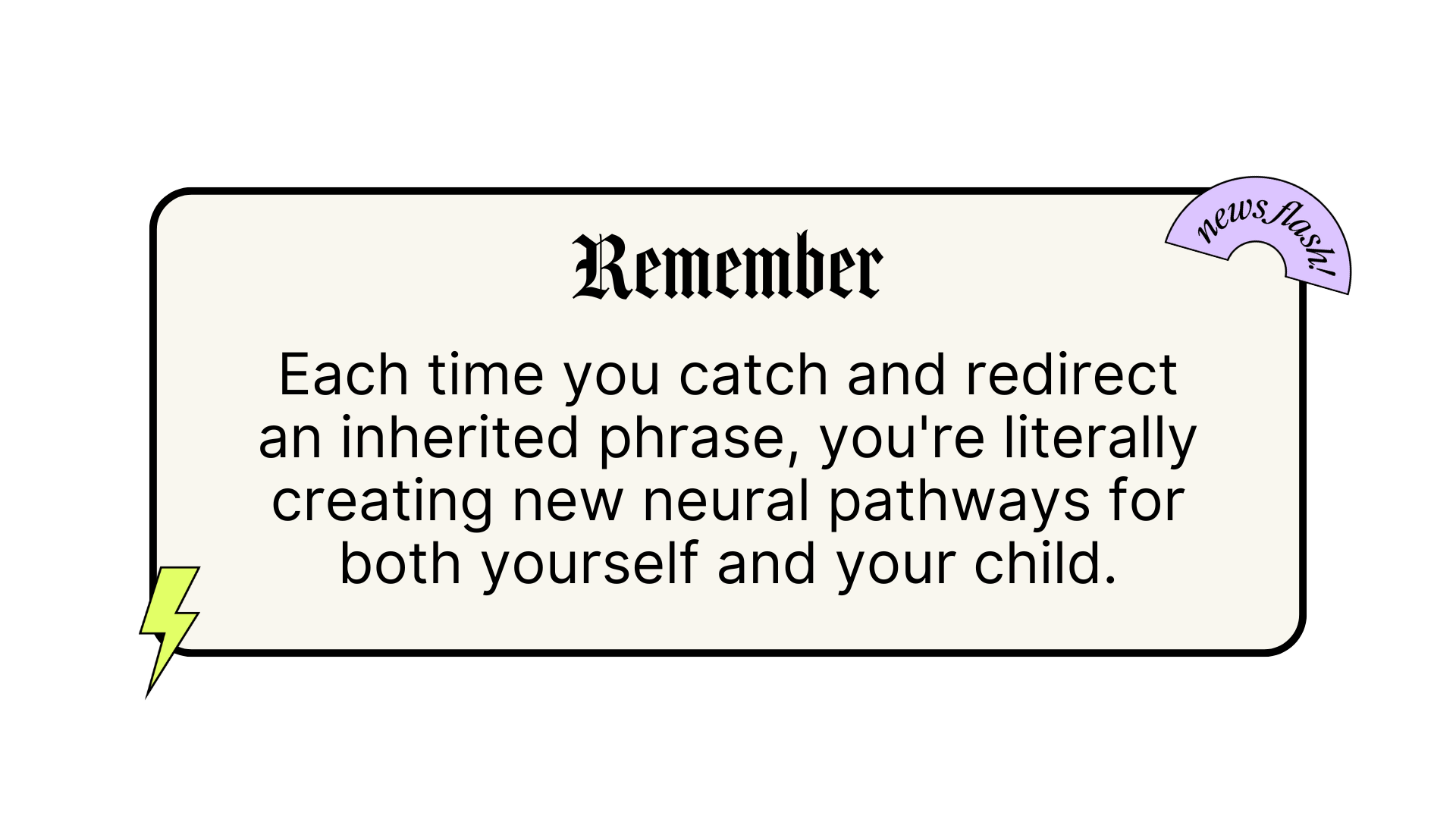
- Your neural pathways were formed in childhood: The discipline phrases you heard repeatedly as a child created deeply grooved neural pathways—your brain's default "emergency responses."
- Stress activates automatic responses: When you're triggered, your brain seeks the most familiar pattern—often the exact phrases you heard thousands of times growing up.
- Generational patterns run deep: These responses aren't just verbal habits; they're connected to how you learned to process emotions, set boundaries, and express frustration.
- Parenting from depletion amplifies triggers: When you're exhausted, hungry, or overwhelmed, your prefrontal cortex has fewer resources to override automatic responses.
What many parents don't realize is that these moments of pattern-repeating aren't character flaws or evidence of failure—they're opportunities for powerful rewiring.
The most common triggers that activate these inherited responses include:
- When your child directly challenges your authority
- During time-pressured transitions (mornings, bedtime)
- When your child's behavior might be judged by others
- When your child exhibits behavior that was punished in your own childhood
The key isn't preventing triggers (impossible!) but recognizing them early enough to choose a different response.