I once found myself in a crowded airport with my 5-year-old daughter, our flight delayed for the third time. As announcements blared and travelers grumbled, I watched her little face crumple in quiet concern.
"What's wrong, sweetheart?" I asked, bending to her level.
"We're never going to get home," she whispered, tears welling. "Daddy will forget about us, and our house will think we don't love it anymore."
In that moment, as I held her tight, I was struck by how catastrophic thinking works in young minds. A delayed flight wasn't just an inconvenience—in her world, it was the beginning of a cascade of abandonment and loss.
I know I'm not alone in witnessing this moment when children's thoughts spiral to the worst possible scenario. Perhaps you've seen it too: a misplaced toy becomes "I'll never see it again," a friend's absence becomes "they don't like me anymore," or a mistake becomes "I'm stupid."
As parents, these moments can pull us in opposite directions. Our logical brain wants to immediately correct these irrational thoughts—"Of course we'll get home!" "Don't be silly!" But our emotional brain recognizes the very real distress our children are experiencing.
During my recent coaching sessions, I've spoken with several parents navigating this exact challenge. One mom described her 6-year-old daughter spiraling into despair after forgetting her new lunchbox at school, declaring she "didn't deserve" to have nice things anymore. Another parent watched her 7-year-old collapse into tears, convinced that a small mistake meant she was "stupid."
The good news? There are concrete, science-backed approaches that can transform these difficult moments into opportunities for emotional growth. And that's exactly what we're exploring in this week's newsletter.
In this week's newsletter you'll learn:
- How to recognize the neurological basis of catastrophic thinking in children, helping you respond with confidence instead of confusion when your child spirals into worst-case scenarios
- Age-specific scripts and strategies that transform overwhelming moments into opportunities for emotional growth, reducing both your stress and your child's anxiety
- A practical three-step process for helping children develop healthier thought patterns, leading to more resilient kids who can better manage their emotional responses
- Evidence-based techniques that strengthen your parent-child connection during difficult moments, creating a foundation of trust that will serve you through the challenging years ahead

THIS WEEK'S TEACHING
The Science Behind Catastrophic Thinking
When your child says, "I'll never get my lunchbox back" or "I'm stupid," they're not being dramatic for attention—they're experiencing a very real emotional response driven by brain development.
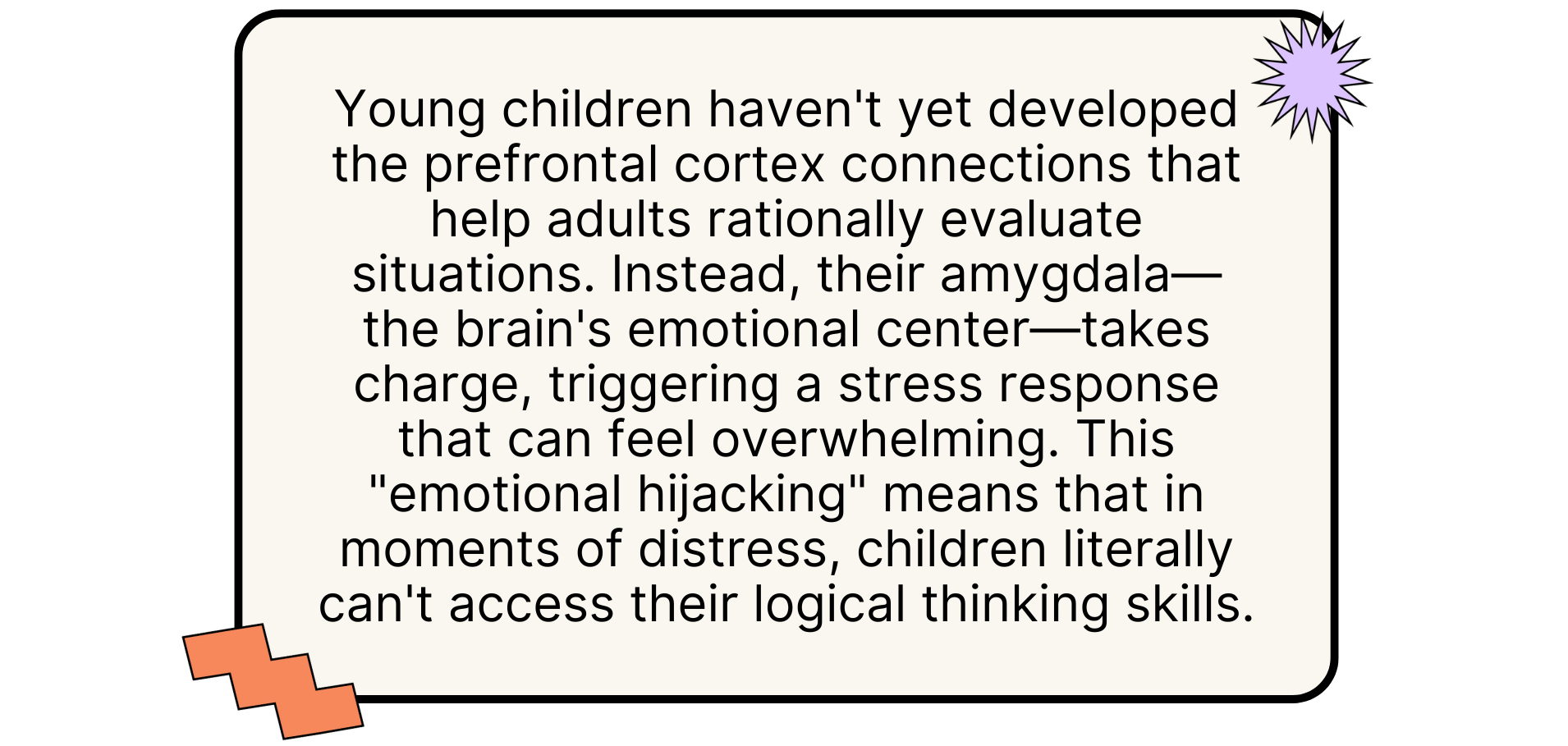
Research from developmental neuroscience shows us that between ages 4-7, children are building crucial neural pathways that will eventually help them balance emotional reactions with rational thought. When we respond effectively to catastrophic thinking, we're actually helping build those pathways.
Three Root Causes of Catastrophic Thinking in Children
- Limited Life Experience: Children haven't yet accumulated evidence that most problems are temporary. Without this perspective, small setbacks can feel permanent and devastating.
- Developing Emotional Regulation: Young children are still learning to identify emotions and manage their intensity. Big feelings can quickly overwhelm their coping abilities.
- Concrete Thinking Patterns: Children tend to think in absolute terms (always/never, everything/nothing). This black-and-white thinking naturally lends itself to catastrophizing.