After reading this, you'll know why your child's summer dysregulation isn't regression and what to actually do in the first week before the whole thing unravels.


It was early morning and I was in the kitchen when I heard my 3-year-old, full volume, losing it at his older sister.
His screaming is a trigger for me. I'm still adjusting to how loud he is (my daughters were never this loud at his age), and the sound of his distress in the morning, when the day hasn't even started yet, sends something through me that I can only describe as dread. I find myself thinking, It's only the morning. We're going to be doing this all day. 😭
So I did what stressed parents do. I looked at my 8-year-old and said, "Just leave him alone. You're eight. One of us has to de-escalate and it can't be him."
I didn't realize until later that I had just asked my soon to be 3rd grader to do something I, someone who has spent over a decade studying child psychology, struggle to do under pressure. Regulate in the middle of chaos, read another person's emotional cues and choose connection over reaction - all the while, dysregulated and needing support herself.
She's 8 and it’s day 3 of summer - Of course she couldn't do it.
That moment is what this issue is about.

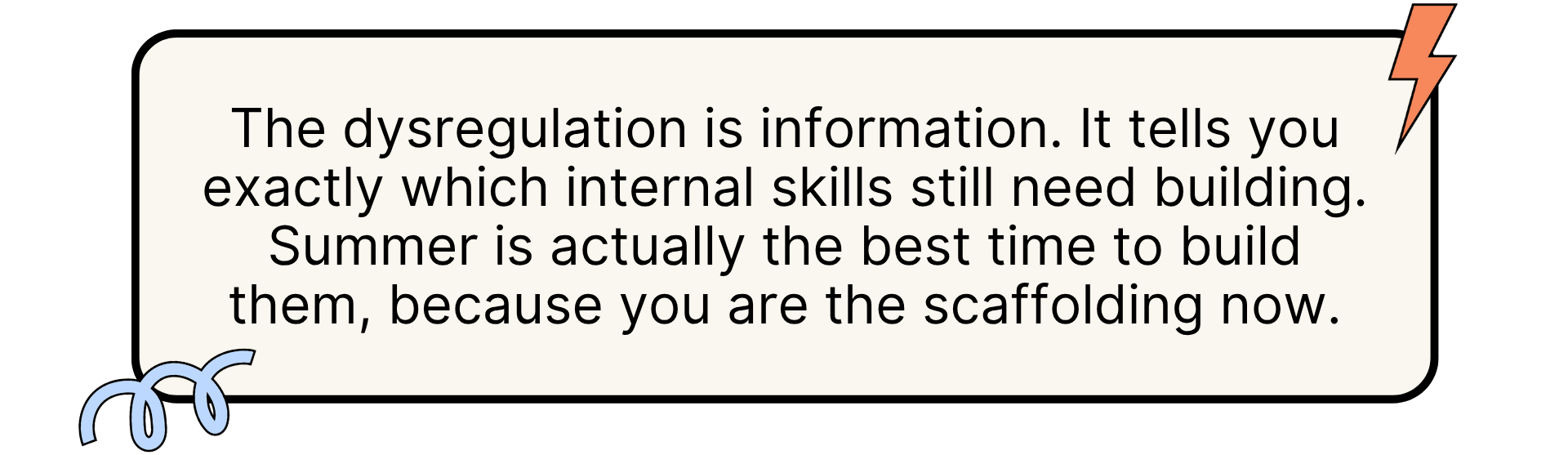
Here's what I want you to understand before summer fully arrives: The child who seemed more regulated during the school year wasn't fully regulated. She was scaffolded. What I mean is she had external structure (i.e., the routine, teacher's expectations, the predictable bell schedule, peer accountability, etc) that was doing regulatory work that her nervous system cannot yet do on its own.
When summer removes that scaffolding, what surfaces isn't new because it was always underneath. Essentially, it’s a completely predictable nervous system response to the loss of external structure.
The part that makes it harder is that most of us interpret summer dysregulation as regression. It’s easy to see all the screaming, bickering, attitude, and defiance as evidence that the work we did all year didn't stick. That interpretation creates shame and hopelessness that makes the summer harder than it needs to be.
So I want to offer you a reframe: