"Mine! That's MINE!"
He's 3, and the floaty is technically his. He carried it all the way in from the car very proudly, the large plastic device nearly bigger than him. Once we finally arrived at the pool, he set it down to get his sunscreen on and shoes off.
In those 4 seconds of putting it down, which, in his sister's defense, looked a lot like he was done with it, she picked it up. But as she turned toward the water, that's when it happened. The loud shriek, and suddenly both kids were gripping the floaty.
The entire quiet pool deck swiveling to watch our family come apart over an inflatable.
"Hey! Give it back! I had it!" she says, because she did have it, sort of.
Here I am, in my swimsuit, my sunscreen barely dry, with an audience.
The part that makes me a little crazy is that just a second ago, we were all fine. Excited to be at the pool as a family for the first time this season.
That's how it often feels, like they're always fine, right up until the second you get out in public or walk into the room.
It feels deliberate, like they wait for you or an audience to lose it. But what’s really going on is it’s the summer and they’re just always within arm's reach of each other now.
That's the part nobody warns you about. School ends, the structure that kept everyone in separate rooms and separate routines disappears, and suddenly 2+ kids are sharing the same space and the same stuff, all day, every day, with nothing to send them to neutral corners.
The floaty fight. The domino fight. The who-got-the-blue-cup fight or who took the last juice argument. On repeat from sun up to sun down.
From the outside it can look like one kid is spoiled and the other is mean.
A mom inside TMP Times described her two girls, ages 3 and 5, in a way that probably sounds familiar: The little one melts down over everything that's "hers," the big one always has to be first and keeps announcing that her piece is bigger, and the whole thing struck her as "a competitive dynamic for no reason."
I want to gently push on that last part, because it's the thing that changes everything.
I know it feels like there’s no reason, but there is. Two of them, actually, one for each kid.
Start with your littlest.
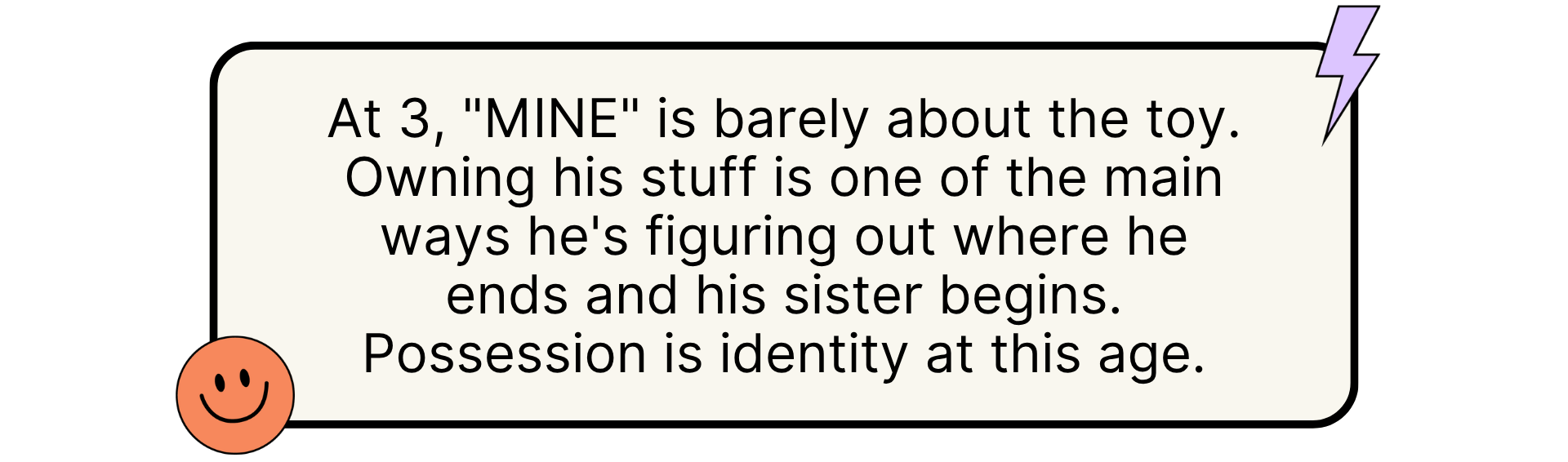
(Another mom in the survey caught the stage in a single line: her 2-year-old "just entered the phase where everything is 'hers' and breaks down when she can't have it." Yep, that sounds about right.)
Sometimes it isn't even about owning the thing. When your toddler has his blocks set up a specific way, or his dominoes lined up just so, and a sibling walks over and moves a piece, it doesn't register as "someone touched my toy." It registers as "someone wrecked the thing I was building." Picture someone closing all your open tabs in the middle of your work and telling you to relax. He has no words for that yet, so it comes out as a shriek, or a shove.
Now your older one, the one who always has to be first and announces that her piece is bigger. It's tempting to read that as bratty. (We dug into the competing-and-needing-to-feel-special piece back in Issue 43, so I won't reiterate it here.) The thing that matters for summer is this:
When there's a little one in the house who screams loud and needs constant help, your older kid is quietly keeping score. Every time you step in for the toddler, she files it away. Her version of the story is the one my own daughters say out loud: "It's not fair. He just yells and screams at us, and he's mean and spoiled." She isn't trying to be difficult. She genuinely feels like she loses, every single time, to a smaller, louder person, and that you're on his side.
So this summer, here’s what I want you to keep in mind:
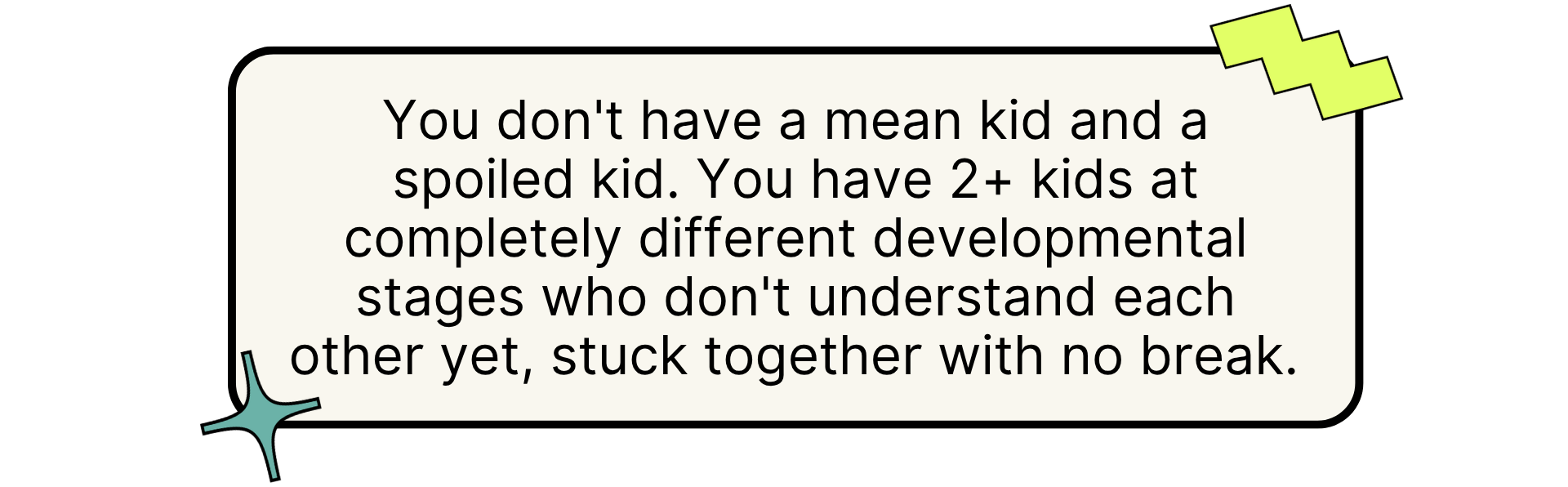
Your younger child can't grasp why his older sibling won't just let him have his thing. Your older one can't grasp why the baby constantly screams and seems to get a pass for it.
Neither of them is wrong. What’s happening is they're speaking different developmental languages.
Which makes your real summer job less "referee" and more "bridge," and the half of that job almost everyone skips is the one that actually lowers the temperature: helping your older child understand your younger one (without excusing the behavior or minimizing their feelings).
After reading this week’s newsletter, you'll have:
- The exact words to defuse the toddler "MINE" explosion without forcing anyone to share
- What to say to your older child so she stops feeling like the baby always wins (the piece that shifts the whole sibling dynamic, and almost no one does it)
- A simple summer setup that prevents half these fights before they start, without "just send them outside"
- How the same approach sounds at every age, from 18 months to age 10
- What to do when it stops being a squabble and someone's about to get hurt